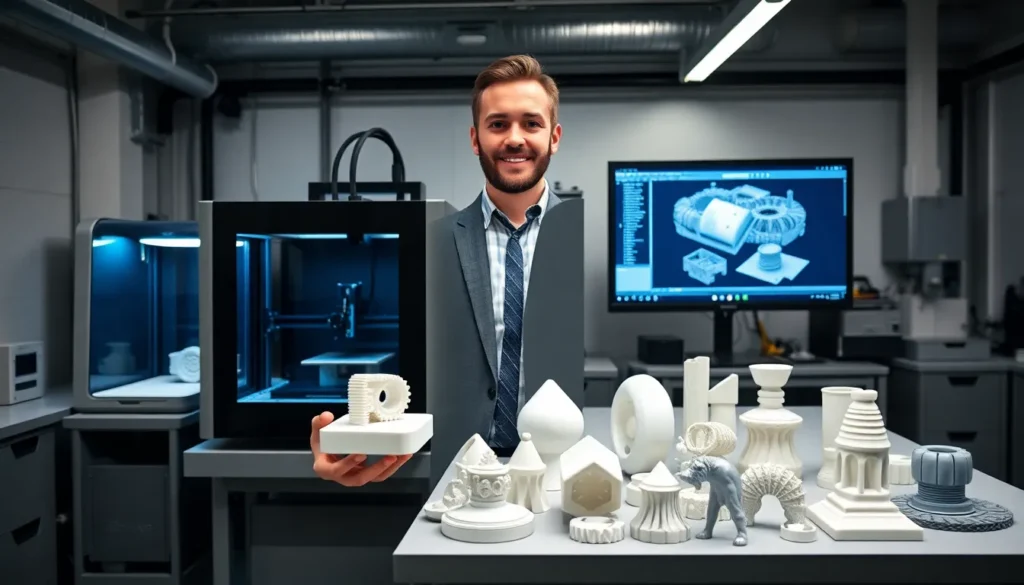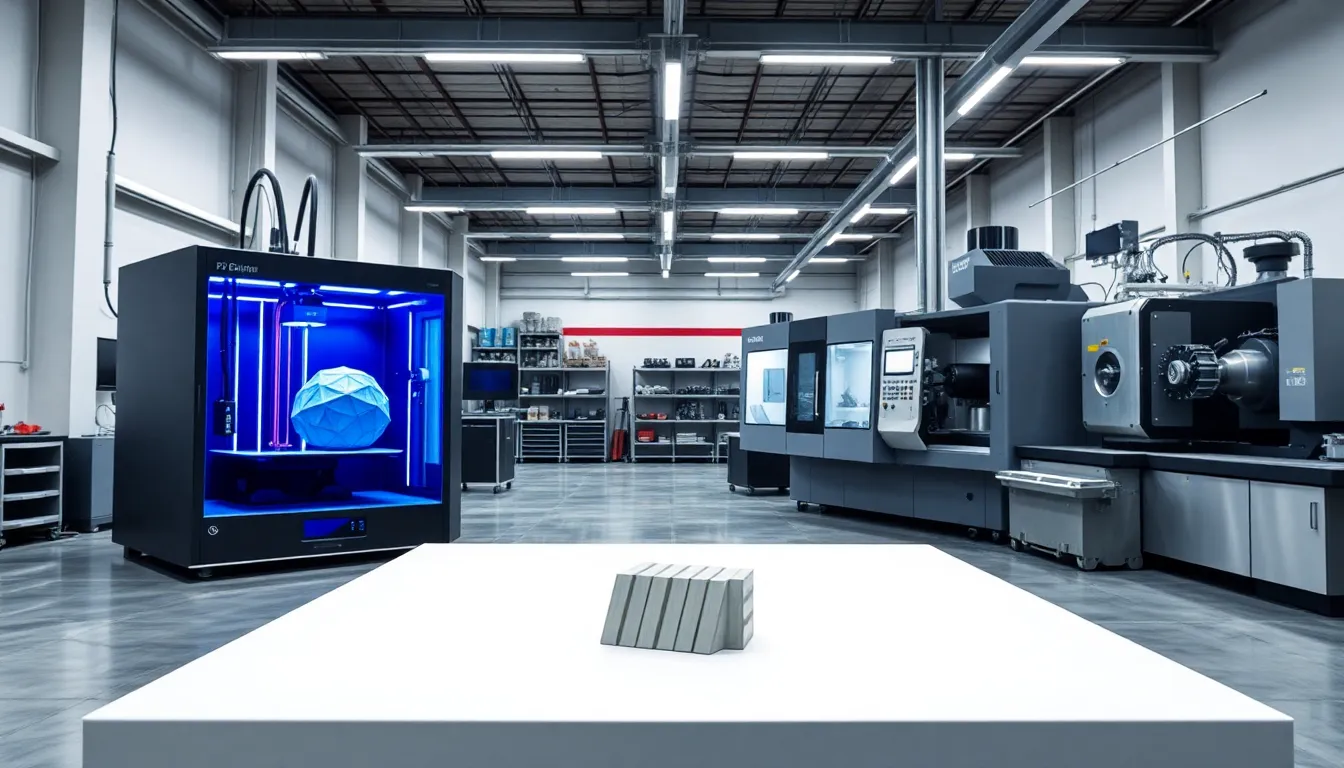

3D printing vs traditional manufacturing represents one of the most important decisions businesses face today. Each method offers distinct advantages depending on project requirements, budget, and timeline. 3D printing builds objects layer by layer from digital files. Traditional manufacturing uses established processes like injection molding, CNC machining, and casting. Both approaches serve different purposes, and choosing the right one can save significant time and money. This guide breaks down the key differences between 3D printing vs traditional methods to help determine which approach fits specific production needs.
Table of Contents
ToggleKey Takeaways
- 3D printing vs traditional manufacturing comes down to volume—3D printing suits small batches under 100-500 units, while traditional methods win on cost for mass production.
- 3D printing requires no tooling and can deliver prototypes in 24-48 hours, whereas traditional manufacturing needs weeks for mold and tooling setup.
- Traditional manufacturing offers lower per-unit costs at scale, with injection molding producing millions of identical parts from a single mold.
- 3D printing enables complex geometries and customization at no extra cost, making it ideal for prototypes and unique parts.
- Many businesses use a hybrid approach: prototyping with 3D printing, then transitioning to traditional manufacturing for high-volume production.
- Traditional manufacturing delivers superior surface finish and consistent mechanical properties, which matter for appearance-critical consumer products.
Understanding 3D Printing Technology
3D printing, also called additive manufacturing, creates physical objects from digital designs. A printer deposits material layer by layer until the final shape emerges. This process starts with a CAD (computer-aided design) file that tells the machine exactly where to place material.
Several 3D printing methods exist today:
- FDM (Fused Deposition Modeling): Melts plastic filament and extrudes it through a nozzle
- SLA (Stereolithography): Uses UV light to cure liquid resin into solid layers
- SLS (Selective Laser Sintering): Fuses powder materials using a laser
- Metal 3D Printing: Builds metal parts using powder bed fusion or direct energy deposition
3D printing shines when producing prototypes, custom parts, or small batches. A designer can send a file to a printer and have a physical part within hours. No molds, no tooling, no setup costs. This flexibility makes 3D printing especially valuable for product development and testing.
The technology has advanced rapidly over the past decade. Modern 3D printers achieve tolerances as tight as 0.1mm and can produce functional end-use parts, not just visual prototypes.
How Traditional Manufacturing Works
Traditional manufacturing encompasses several established production methods. These processes have powered industry for decades and remain the backbone of mass production.
Injection Molding forces molten plastic into a metal mold cavity. Once cooled, the part ejects and the cycle repeats. A single mold can produce millions of identical parts with excellent consistency.
CNC Machining removes material from a solid block using computer-controlled cutting tools. This subtractive process creates precise metal and plastic components with tight tolerances.
Die Casting pours molten metal into reusable molds under high pressure. This method produces complex metal parts quickly once tooling exists.
Stamping and Forming shapes sheet metal using dies and presses. Automotive body panels and appliance housings often use these techniques.
Traditional manufacturing requires upfront investment in tooling. A single injection mold can cost $10,000 to $100,000+ depending on complexity. But once that tooling exists, per-unit costs drop dramatically. Producing 100,000 plastic parts through injection molding costs a fraction of what 3D printing the same quantity would require.
These methods excel at repeatability. Every part comes out nearly identical, which matters for products requiring consistent quality across millions of units.
Key Differences in Cost and Speed
Cost structures differ fundamentally between 3D printing vs traditional manufacturing. Understanding these differences helps determine which method makes financial sense.
3D Printing Costs:
- Low startup costs (no tooling required)
- Linear scaling, 100 parts costs roughly 100x one part
- Material costs range from $20-$500/kg depending on type
- Machine time becomes the primary expense
Traditional Manufacturing Costs:
- High upfront tooling investment
- Dramatically lower per-unit costs at volume
- Material costs typically lower due to bulk purchasing
- Labor and machine setup factor into pricing
The breakeven point varies by part complexity and material. Generally, 3D printing makes sense for quantities under 100-500 units. Beyond that threshold, traditional manufacturing often wins on cost.
Speed Comparison:
3D printing delivers faster time-to-first-part. A prototype can go from design to physical object in 24-48 hours. Traditional manufacturing requires tooling production first, which takes weeks or months.
But, traditional manufacturing produces parts faster at scale. An injection molding machine cycles every 15-60 seconds. A 3D printer might take 2-8 hours for the same part. For high-volume production, traditional methods are significantly faster overall.
The 3D printing vs traditional debate often comes down to this tradeoff: speed to start versus speed at scale.
Material Options and Quality Considerations
Material selection impacts both the manufacturing method choice and final product performance. Each approach offers different options.
3D Printing Materials:
- Standard plastics (PLA, ABS, PETG)
- Engineering polymers (Nylon, PEEK, Ultem)
- Photopolymer resins with varying properties
- Metals including titanium, stainless steel, aluminum, and tool steels
- Composites with carbon fiber or glass reinforcement
Traditional Manufacturing Materials:
- Virtually any plastic formulation
- All common metals and alloys
- Specialty materials like ceramics and glass
- Rubber and elastomers
- Wood, paper, and organic materials
Traditional manufacturing still offers broader material selection, particularly for specialized applications. Certain high-performance polymers and metal alloys work better with conventional processes.
Quality Differences:
3D printed parts often show layer lines on their surfaces. Post-processing like sanding, polishing, or vapor smoothing can improve appearance but adds cost and time.
Injection molded parts typically have smoother surfaces straight from the mold. CNC machined components achieve excellent surface finishes and dimensional accuracy.
Mechanical properties also differ. 3D printed parts can have directional strength, stronger in some orientations than others due to layer bonding. Traditional manufacturing generally produces more isotropic (uniform) material properties.
For appearance-critical consumer products, traditional manufacturing often delivers better results. For functional prototypes or hidden components, 3D printing works perfectly well.
When to Choose Each Method
Selecting between 3D printing vs traditional manufacturing depends on specific project requirements. Here’s when each method makes sense.
Choose 3D Printing When:
- Producing prototypes or proof-of-concept models
- Making fewer than 100-500 units
- Parts require complex geometries impossible with other methods
- Customization matters (every part can be unique at no extra cost)
- Speed to market is critical
- Testing multiple design iterations quickly
- Producing spare parts on-demand rather than maintaining inventory
Choose Traditional Manufacturing When:
- Producing thousands or millions of units
- Per-unit cost must be minimized
- Surface finish and appearance are priorities
- Material requirements exceed 3D printing capabilities
- Consistent mechanical properties are essential
- Parts must meet specific regulatory certifications
- Long-term production runs are planned
Hybrid Approaches:
Many companies use both methods strategically. They prototype with 3D printing, then transition to traditional manufacturing for production. Some use 3D printing to create molds or tooling for traditional processes, reducing lead times.
The best approach treats 3D printing and traditional manufacturing as complementary tools rather than competitors. Each has its place in a complete manufacturing strategy.